

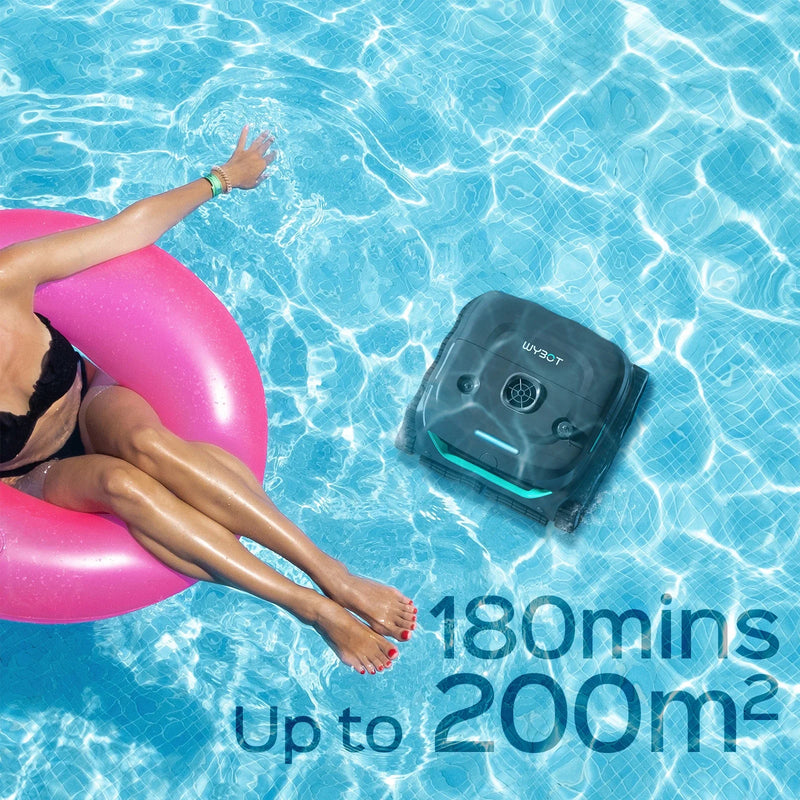
Robotic pool cleaners have transformed pool maintenance by reducing manual labor and delivering consistent cleaning performance. Among the popular options available today, the WYBOT C1 and WYBOT C2 have attracted significant attention from pool owners looking for efficient and intelligent cleaning solutions. While both models offer advanced features and cordless convenience, one of the most frequently asked questions is: Which model has better wall climbing performance?
Wall climbing is a crucial capability for robotic pool cleaners because dirt, algae, debris, and fine particles often accumulate not only on the pool floor but also along the walls and waterline. A cleaner that can effectively navigate vertical surfaces provides more comprehensive coverage and a cleaner swimming environment.
In this detailed comparison, we examine the wall climbing abilities of the WYBOT C1 and WYBOT C2 while exploring the factors that influence their overall cleaning performance.
Why Wall Climbing Matters in Pool Cleaning
Many pool owners focus primarily on floor cleaning when selecting a robotic cleaner. However, walls and waterlines require equal attention to maintain a sparkling pool.
Pool walls are exposed to constant water circulation, chemical reactions, sunlight, and environmental contaminants. Over time, these conditions can lead to the buildup of dirt, biofilm, and mineral deposits. If left untreated, these areas can become difficult to clean manually.
A robotic cleaner with strong wall climbing capability can:
- Remove debris from vertical surfaces
- Clean hard-to-reach pool corners
- Reduce algae accumulation
- Improve waterline cleanliness
- Deliver more complete pool coverage
For this reason, wall climbing performance has become one of the most important purchasing considerations for modern pool owners.
Understanding the WYBOT C1
The WYBOT C1 was designed as a versatile cordless robotic pool cleaner suitable for many residential pools. It combines intelligent navigation technology with powerful suction and multiple cleaning modes.
One of the standout characteristics of the C1 is its balanced design. The cleaner is engineered to transition smoothly between the pool floor, walls, and waterline areas.
The machine uses advanced traction systems that help maintain contact with vertical surfaces while climbing. Combined with efficient route planning, the C1 can clean large sections of pool walls without unnecessary repetition.
For pool owners with standard in-ground pools, the C1 provides reliable wall climbing performance and consistent cleaning coverage.
Understanding the WYBOT C2
The WYBOT C2 represents a newer generation of robotic pool cleaning technology. It builds upon many of the strengths of previous models while introducing refinements aimed at improving overall cleaning efficiency.
The C2 features upgraded navigation algorithms, enhanced motor performance, and optimized movement control systems. These improvements help the cleaner maintain stability while traveling across different pool surfaces.
When approaching walls, the C2 is designed to generate strong traction and maintain steady movement. This allows the unit to climb effectively while minimizing slippage.
Its intelligent route management system also contributes to more efficient wall coverage by reducing missed areas and improving cleaning consistency.
Comparing Wall Climbing Performance
When directly comparing wall climbing capabilities, both the C1 and C2 perform well in residential pool environments. However, there are several distinctions worth considering.
The WYBOT C1 delivers dependable wall climbing performance and is capable of cleaning most pool wall surfaces effectively. It transitions smoothly between horizontal and vertical areas and performs particularly well in standard pool shapes.
The WYBOT C2, meanwhile, benefits from refinements in navigation and movement control. These upgrades often allow the cleaner to maintain better stability during vertical climbs and provide more consistent wall coverage.
In pools with complex shapes, deeper sections, or more challenging wall transitions, the C2 may demonstrate a slight advantage in maintaining climbing efficiency.

Traction Technology and Surface Grip
Wall climbing performance depends heavily on traction technology. A robotic cleaner must generate sufficient grip to overcome gravity while maintaining contact with the pool surface.
The WYBOT C1 uses an effective traction system that provides reliable performance on common pool finishes, including concrete, vinyl, and fiberglass.
The WYBOT C2 enhances this concept through improved drive mechanisms and optimized movement patterns. These enhancements help the cleaner maintain stronger surface contact while navigating slopes and vertical walls.
As a result, the C2 often appears more confident during prolonged wall-cleaning cycles.
Waterline Cleaning Efficiency
For many pool owners, waterline cleaning is the true test of wall climbing ability.
The waterline is where oils, sunscreen residue, and floating debris tend to accumulate. Effective cleaning requires the robot to climb high enough and maintain stable positioning while scrubbing.
Both the C1 and C2 are capable of reaching waterline areas. However, the C2’s upgraded control system may provide slightly improved consistency during repeated waterline cleaning passes.
This advantage can contribute to a cleaner and more polished pool appearance over time.
Navigation and Coverage Intelligence
Modern robotic cleaners rely heavily on navigation software. Wall climbing alone is not enough if the cleaner cannot efficiently cover the entire pool.
The WYBOT C1 uses intelligent route planning to avoid excessive overlap and improve cleaning efficiency. It provides solid coverage for most residential pools.
The C2 introduces more advanced navigation logic that further optimizes movement patterns. This can lead to better wall coverage, particularly in pools with unusual layouts or multiple depth changes.
Improved navigation also helps ensure that wall climbing efforts are distributed evenly throughout the cleaning cycle.
Battery Performance During Wall Cleaning
Wall climbing places greater demands on a robotic cleaner compared to floor cleaning.
The motors must work harder to maintain vertical movement and traction. Therefore, battery efficiency becomes an important factor.
Both models are designed to provide sufficient runtime for comprehensive cleaning sessions. The C2’s newer energy management technologies may offer additional efficiency benefits during extended wall cleaning operations.
This helps maintain consistent performance throughout the cleaning cycle.
Which Pool Types Benefit Most from Each Model
The WYBOT C1 is an excellent choice for pool owners seeking reliable wall climbing and dependable overall cleaning performance. It performs particularly well in standard residential pools with straightforward layouts.
The WYBOT C2 is especially attractive for pools that feature:
- Complex shapes
- Multiple depth levels
- Large wall surfaces
- Extensive waterline areas
- Demanding cleaning requirements
Its enhanced climbing stability and navigation intelligence make it well-suited for these environments.
Which Model Has Better Wall Climbing?
When comparing the WYBOT C1 and WYBOT C2 strictly on wall climbing performance, the WYBOT C2 generally holds a slight advantage.
Its upgraded navigation system, refined movement control, enhanced traction management, and improved cleaning efficiency contribute to more consistent wall and waterline cleaning.
That said, the WYBOT C1 remains a highly capable robotic pool cleaner that offers strong wall climbing performance for most residential pools. For many pool owners, it delivers excellent results and reliable cleaning coverage.
Ultimately, both models provide impressive wall climbing capabilities, but pool owners seeking the latest advancements in vertical cleaning performance may find the WYBOT C2 to be the stronger option. Choosing between the two will depend on pool size, shape, cleaning expectations, and personal preferences, but either model can help maintain a cleaner, healthier, and more enjoyable swimming environment.


