

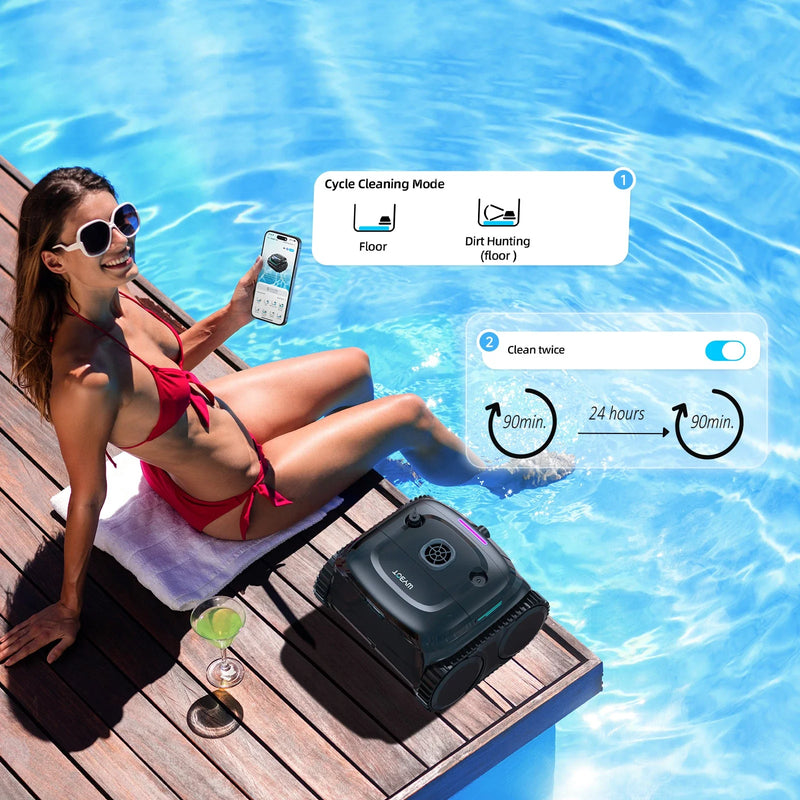
Keeping a swimming pool clean is essential for maintaining water quality, swimmer safety, and the overall lifespan of pool equipment. Today, pool owners can choose between advanced robotic pool cleaners and traditional cleaning methods such as manual vacuums, suction-side cleaners, and pressure-side systems. While both options can help maintain a clean pool, they differ significantly in convenience, efficiency, operating cost, and overall user experience.
Pool Cleaning Robot vs Traditional Cleaning Methods Comparison
| Feature | Pool Cleaning Robot | Traditional Cleaning Methods |
|---|---|---|
| Cleaning Process | Fully automated cleaning | Mostly manual or semi-automatic |
| User Effort | Minimal involvement required | Requires regular manual labor |
| Cleaning Coverage | Systematic and efficient | Often uneven or random |
| Wall Climbing Ability | Most models can clean walls and waterlines | Limited or unavailable |
| Cleaning Speed | Faster and more optimized | Usually slower |
| Debris Removal | Handles leaves, sand, algae, and fine dirt | Better for larger debris only |
| Filtration System | Built-in independent filtration | Relies on pool filtration system |
| Energy Consumption | Low energy usage | Higher due to pool pump dependence |
| Pool Pump Wear | Reduces stress on pool system | Increases pump workload |
| Smart Features | App control, scheduling, navigation | Very limited smart functions |
| Cord Management | Cordless models available | Hoses and cords can tangle |
| Maintenance Difficulty | Easy filter cleaning | More equipment maintenance |
| Water Quality Improvement | Better fine-particle filtration | Standard filtration performance |
| Time Required | Usually 1–3 hours automatically | Several hours of manual work |
| Long-Term Cost | Lower maintenance and energy cost | Higher operational expenses |
| Best For | Busy homeowners and large pools | Small pools and budget users |
Cleaning Efficiency
Pool cleaning robots are designed to maximize cleaning performance with intelligent navigation and optimized cleaning paths. Many modern robotic cleaners can detect pool shapes, avoid obstacles, and clean floors, walls, and waterlines efficiently.
Traditional cleaning methods often rely on manual movement or random navigation patterns. This can leave dirt behind in corners or difficult-to-reach areas. Manual brushing and vacuuming may also require frequent repetition to maintain clear water.
For pools surrounded by trees, dust, or heavy debris, robotic cleaners usually provide more consistent results.
Convenience and Ease of Use
Convenience is one of the biggest reasons pool owners choose robotic cleaners. Most robotic pool vacuums only require placing the unit in the water and starting the cleaning cycle. After cleaning, users simply remove and rinse the filter basket.
Traditional cleaning methods involve significantly more work. Pool owners often need to connect hoses, manage equipment, brush surfaces manually, and monitor the cleaning process closely.
Cordless robotic pool cleaners further improve convenience by eliminating tangled cables and complicated setup procedures.

Energy and Operating Costs
Traditional suction-side and pressure-side cleaners depend heavily on the pool’s pump system, which increases electricity usage. Extended pump operation can also create additional wear on the pool filtration equipment.
Robotic pool cleaners operate independently with energy-efficient motors or rechargeable batteries. Because they do not rely on the pool circulation system, they often reduce overall energy consumption and help extend the life of pool equipment.
Although robotic cleaners usually cost more upfront, many users save money over time through lower maintenance and electricity expenses.
Cleaning Performance on Different Pool Types
Modern robotic pool cleaners are compatible with many pool surfaces, including concrete, vinyl, fiberglass, and tile pools. Advanced brush systems allow them to scrub away algae, dirt, and debris without damaging delicate surfaces.
Traditional cleaning tools may require different attachments for different pool materials, and improper use can sometimes scratch or wear sensitive surfaces.
Robotic cleaners are also better suited for pools with complex shapes, slopes, steps, and deep sections.
Smart Features and Technology
Modern pool cleaning robots often include advanced technology features such as:
- Intelligent navigation systems
- Mobile app control
- Scheduled cleaning modes
- Auto-parking functions
- Multiple cleaning cycles
- Rechargeable cordless operation
Traditional cleaning systems typically lack these smart functions and require more direct supervision.
Smart robotic technology allows users to maintain cleaner pools with less effort and greater flexibility.
Maintenance Requirements
Both robotic and traditional systems require maintenance, but robotic cleaners are usually easier to manage.
Typical robotic cleaner maintenance includes:
- Emptying the filter basket
- Charging the battery
- Cleaning the brushes
- Rinsing the debris compartment
Traditional systems may require:
- Hose replacement
- Pump maintenance
- Pressure adjustments
- Skimmer cleaning
- Manual vacuum repairs
Over time, robotic cleaners can help reduce stress on the overall pool system.
Which Cleaning Method Is Better?
The ideal cleaning solution depends on pool size, budget, and user preferences.
Traditional cleaning methods may still work well for small pools with minimal debris and owners who do not mind manual maintenance.
However, robotic pool cleaners are becoming the preferred option for modern pool owners because they offer:
- Better automation
- Improved cleaning performance
- Lower energy consumption
- Time savings
- Easier operation
- Smarter technology integration
For users seeking a low-maintenance and efficient pool cleaning solution, robotic cleaners provide strong long-term value.
When comparing pool cleaning robots vs traditional cleaning methods, robotic cleaners clearly offer advantages in efficiency, convenience, and modern functionality. Traditional methods can still handle basic cleaning tasks, but they often require more physical effort and ongoing maintenance.
As robotic technology continues to improve, more pool owners are switching to automated pool cleaners to simplify maintenance and keep their pools consistently clean with minimal effort.


